

Key Takeaways
- Free traffic refers to visitors who arrive at your dropshipping store organically, without paid ads.
- Free traffic is essential for building trust, credibility, long-term sustainability, higher conversion rates, and brand authority.
- The seven pillars of organic traffic growth include SEO, content marketing, social media, question-and-answer forums, email marketing, affiliate programs, and diversified product offerings.
- Avoiding common mistakes in free traffic sourcing helps you maximize results and prevent wasted effort.
- Use Google Analytics (GA4) and Google Search Console (GSC) to measure, analyze, and optimize your free traffic performance.
You’ve done the research, picked your products, ready to launch your dropshipping store and make your first sales. But there’s one small problem: no one is visiting your store.
Think about investing in paid ads, but what about when you stop running ads? Here comes the organic or free traffic dropshipping strategy; visitors who find your website through unpaid search engine results. And the best part?
It not only builds lasting customer relationships but also ensures your store ranks high organically. Ready to turn your store into a traffic magnet? Dive deeper into the 7 proven ways to get free traffic to your dropshipping store.
Table of Contents
What is free traffic dropshipping?
Free or organic dropshipping refers to a dropshipping business model that focuses on attracting customers and generating sales through free marketing efforts, without upfront costs. Here, you need to utilize organic marketing strategies, such as SEO, content marketing, social media platforms, and others, rather than investing in paid ads.
In short,
- Free traffic dropshipping methods build slowly & require consistency.
- Organic or free dropshipping refers to unpaid traffic to your store.
- Organic dropshipping requires time to get results.
Why free traffic matters for a dropshipping store?
Free or “organic” traffic is the foundation of a profitable, scalable, and long-lasting dropshipping business success. Here’s why:
- Low overhead & risk
Dropshipping is an attractive and profitable business idea due to its low startup costs. Paid ads (Facebook, Instagram, Google, etc.) require a high investment, which might get expensive quickly if your products have a low margin. Here, free traffic methods, like SEO, social media, content marketing, and others, are the best way to boost potential traffic.
- Sustainable & long-term growth: Paid traffic might stop scrolling if your product doesn’t appear in Google snippets. But free traffic sources like SEO and a strong social media presence can provide consistent, ongoing visitors.
- High-intent organic traffic: Organic traffic comes naturally to your store. If your store is well-optimized and niche-specific, visitors will turn into potential customers and be interested in repeat purchases.
Brand awareness & recognition: Methods used to generate free traffic—such as content marketing, community engagement, and gathering positive customer reviews—help establish a brand’s reputation and build customer trust and loyalty. This is vital in a competitive e-commerce landscape where customers need a reason to choose one store over another.
Paid vs Free traffic pros & cons
Paid traffic offers fast, targeted results and budget control, ideal for immediate needs like product launches. On the contrary, free traffic is slower but builds authority and sustainability with repeat & long-lasting consumers.
The key difference between paid and free traffic is as follows:
Pros & cons of paid traffic for a dropshipping store:
| Pros | Cons |
| 1. Instant results (ads can generate sales within hours or days) depend on the niche | 1. High competition & high investment require |
| 2. Scalable (requires a winning product & creative combo) | 2. Requires expertise (effective ad management requires targeting, bidding & copywriting skills) |
| 3. Precise targeting (allows you to reach specific demographics, interests, and locations) | 3. Ad fatigue & bidding wars (competitors drive up ad costs, and audiences can see the same ad repeatedly) |
| 4. Great for product testing (ad platforms offer clear data on performance metrics like ROAS) | 4. Zero longevity |
| 5. Short-term revenue boost (perfect for launching new offers & seasonal promotions) |
Pros & cons of free traffic for a dropshipping store:
| Pros | Cons |
| 1. Perfect for small businesses or entrepreneurs | 1. Time-consuming, yet effective results |
| 2. Long-term traffic engagement for months or years | 2. Requires consistency (frequent videos, helpful posts, SEO content, value-based emails, etc.) |
| 3. Build trust & credibility | 3. Less control (can’t track traffic fluctuation based on algorithm updates) |
| 4. No fear of ad rejections or rising ad costs | 4. Skill required (SEO, video editing, product demonstration, writing, etc.) |
| 5. Higher profit margins with repeat customers | |
| 6. Strong brand building (community, loyalty & authority) | |
| 7. Higher ROI over time |
Is organic dropshipping for you?
Free or organic marketing for your dropshipping business won’t require an ad budget like paid ones. All it requires is time and creative strategies, which we’ll discuss in the following section. So, before investing, ask yourself:
- Do you have the time & energy to invest in organic marketing? Planning and editing videos, writing blogs, commenting back to social followers, and responding to customer DMs can take much more time than setting up paid ads.
- Is there a passionate community for your product? Organic dropshipping appeals to business owners who want to build long-term relationships rather than pursue quick sales. Some products naturally perform better with organic marketing, like pet foods, home improvements, etc.
- Is your online store good enough to convert organic visitors? Organic or free traffic works best when your store: loads fast, has strong product pages, mobile mobile-friendly, has social proof, and has clear product details. If your store isn’t professional, organic traffic won’t convert.
- Do you want quick sales or long-term growth? Free traffic or organic traffic takes time. If you expect results in 24 hours, then it isn’t your priority. Organic traffic is for you if:
- You’re willing to build a long-lasting brand identity.
- You prefer long-term consistency over quick spikes.
- You’ve SEO skills, content, and community marketing experience.
- Do you’ve expertise in your niche? Organic means product-oriented marketing, where your primary focus is educating, encouraging, and building consumer confidence in your product.
7 proven ways to get free traffic to your dropshipping store
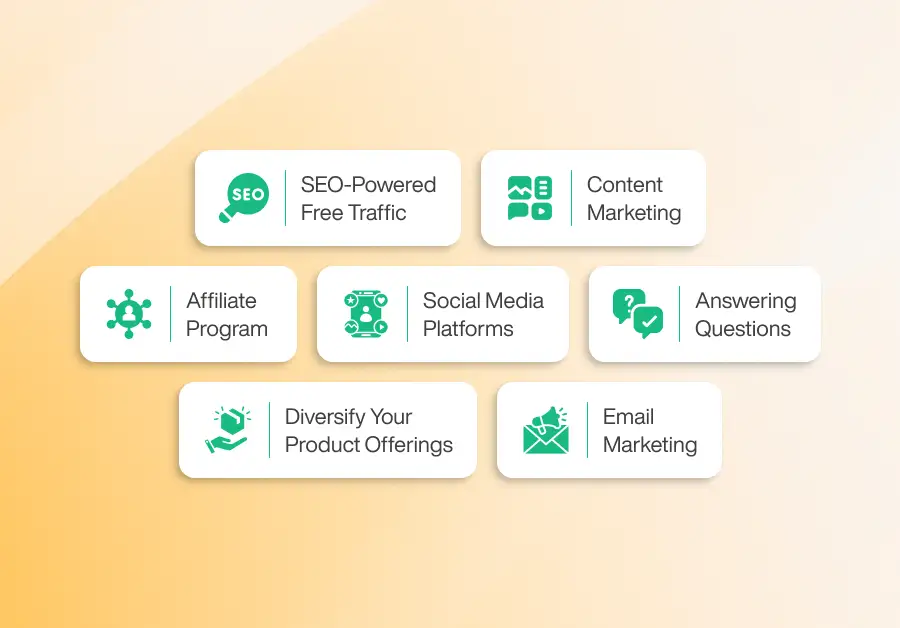
Driving free traffic to your store isn’t about a single tactic; it’s about a holistic approach that builds on several marketing strategies. Below, we’ve highlighted the top 7 proven ways to get free traffic to your dropshipping store.
1. SEO-powered free traffic
Before spending your valuable hours on social media posts or content creation, ensure your online shop is set up perfectly and found in search engines. Think of SEO as your store’s foundation. Without implementing SEO, even your best marketing efforts won’t reach their full potential.
Here are key SEO tactics for your organic dropshipping store:
Master keyword research
Start by analyzing your potential traffic, like what customers are actually searching for. Long-tail keywords are your superior in free traffic sourcing. Instead of competing for “phone case,” you can target “waterproof phone case” or “custom cat phone case iPhone 14.” These specific searches will have less competition and attract buyers who know exactly what they want.
How to start with keyword research:
- Use tools like Google’s Keyword Planner, Ubersuggest, Ahrefs, or Semrush to find relevant, low-competition long-tail keywords your target audience is searching for.
- Analyze competitors to get an idea of what keywords they are ranking for.
- Pick keywords that match your products.
| Pro tip: Focus on keywords with moderate search volume but low competition for faster results. |
SEO-optimize product page
Now, you’ve your niche-specific keyword lists, focus on on-page SEO, such as:
- Product titles & descriptions: Use clear, descriptive titles that include your primary keyword. Write product-specific, unique, and engaging descriptions that highlight benefits and solve customer problems. Use headers (H1, H2, and H3) and bullet points for readability.
- Meta titles & descriptions: Craft compelling meta titles (around 60 characters) and meta descriptions (around 150-160 characters) with your main keyword to improve CTR.
- Image optimization: Use high-quality and optimized product images. Write descriptive alt text for all images using relevant keywords.
- SEO-friendly URLs: Use clean, descriptive URL structures (i.e.,yourstore.com/products/custom-t-shirts) instead of generic IDs.
- Internal linking: Link to related products or relevant blog posts within your product descriptions to create a strong site structure and guide buyers to more options.
High-value collection pages
Search engines often rank product “collection pages” higher than individual product pages. Also, it creates a content cluster that ranks for multiple related keywords. The best practices to apply this SEO hack are:
- Add 200-400 words of descriptive text above/below the products
- Use a keyword-optimized H1 title
- Place sub-collections for filtering (i.e., “Winter”, “Travel-ready”, “Apparel”)
Building high-quality backlinks (off-page SEO)
Backlinks are when other websites link to yours. It is a primary Google ranking factor that helps improve your store’s visibility in search engine results, drive organic traffic, and build authority. Some effective backlink strategies include:
- Guest posting: Guest blogging, tutorials, or natural linking is a powerful signal for your store.
- Collaborate with influencer/review sites: Send free product samples to bloggers or influencers in your niche for reviews. Their posts help you to generate valuable backlinks and social proof.
- Leverage business networks & suppliers: You can ask your suppliers to list your store on their “where to buy” pages, or exchange testimonials for case studies that include links.
Improve page speed
To stay ahead of your competitors & get organic traffic, optimizing your store’s page speed is crucial for SEO success. Marketers state that even small reductions in load time add benefits: an 8.4% increase in conversion rate and a 9.2% increase in AOV.
Below, we’ve showcased some key tactics on how to improve page speed to get potential organic traffic:
- Export images in WebP, upload 3000-4000px images, and compress up to 70% without losing visible quality.
- Lazy loading ensures images load only when visible, reducing initial page load.
- Remove unused Shopify apps.
- Minify JS & CSS to load the site faster.
- Use a global CDN to help visitors from the US, UK, EU, and Asia load your site simultaneously.
- Optimize product pages.
- Optimize your website using tools like PageSpeed Insights and Test My Site.
Consider AI
Traditional search engines like Google and Bing are incorporating generative AI features to provide direct, comprehensive answers to complex, conversational queries and to enhance the overall user experience. To optimize AI overviews, Google AI mode, and LLMs (large language models), here are a few tactics you can try:
- Add expertise: Google E-E-A-T (experience, expertise, authoritativeness, and trustworthiness) has been a ranking factor for years. Relevant statistics, academic studies, and an expert point of view can help your webpages rank well in AI-powered search results.
- Experiment with video: If you’re not on a YouTube channel, it’s time to start a YouTube channel because videos show up frequently in AI search results.
Focus on product benefits: To optimize your product pages for LLMs, focus on product benefits and use cases.
2. Content marketing
Dropshipping customers want to know about products: do those resolve their problem, and do they trust investing in your product? To answer their queries, the best solution is content marketing.
Effective blog posts
Think about your customers’ questions before buying your products, for example,
- How do I clean my yoga mat?
- Which size should I order?
- What’s the difference between the two phone cases (your & competitors’ product)?
- Is this product safe or durable?
Turn all these questions into effective blog posts. Write product comparisons, how-to guides, and buyer’s guides to build trust and visibility. All this content not only increases your SEO, but it also positions you as an expert business owner who knows their selling product perfectly.
Stay consistent
Aim for one quality post per month, even if it’s short, but help to build consistency. For this, you can develop a sustainable posting schedule that helps you to maintain consistency. However, you can utilize a content calendar to maintain and track blog publishing progress.
Repurpose your content
Another effective way to boost free traffic is: repurposing content. Like, you can use blog posts as your social media content, email newsletters, and even product descriptions. Remember, one well-researched post can fuel weeks of marketing material.
UGC (User Generated Content)
Do you know your happiest shoppers are your best marketers? UGC or user-generated content not only builds brand awareness, but it also expands your reach to new traffic. Let’s take a look at the statistics below:
- Salsify shared a report on their 2024 Consumer Research that around 40% of shoppers say UGC is “extremely” or “very” important when making a purchase decision.
- Whereas, Billo in 2025, states that 6 in 10 consumers believe that UGC represents the most authentic form of marketing content.
So, to leverage UGC content marketing, you can:
- Create a branded hashtag for your dropshipping store,
- Offer small incentives like discount codes for shares and reviews, and
- Follow up after purchases with a friendly email asking for product photos.
3. Social Media platforms
How to advertise your dropshipping store for free through social media? Well, the secret is choosing one or two platforms where your ideal customers spend more time. For example, if you sell custom jewelry, Instagram & Pinterest are the best bet. But for tech accessories, try Instagram & TikTok.
Quotation:
Implement the 80/20 rule: 80% valuable, entertaining, or educational content about the product and 20% direct product promotion.
Here’s a detailed social media platform strategy to enhance your dropshipping store’s free traffic:
YouTube
YouTube is great for long-form content and driving potential traffic to your store. The key strategies you can follow:
- Product reviews & unboxing videos – products in action, explain benefits, and link to your store in the description. For example, Dr. Squatch’s men’s natural soap video.
- Educational videos – help consumers know about your dropshipping business niche. For example, if you sell pet treats or accessories, you can share which products are useful for their gut health.
- How-to tutorials – address problems that your offered products solve.
- Engage with community: Respond to comments and include calls-to-action to visit your store.
| Pro tips: Must add high-quality visuals, pinned comments, and links so that viewers can visit your store or dropshipping product page. |
The best platform with billions of active users is useful for visual product display and brand storytelling. To leverage this platform, you can utilize:
- Reels & short videos – showcase products creatively.
- Carousel posts – educate or entertain through promoting products.
- Stories & polls – engage your audience and drive clicks via links.
- User-generated content (UGC) – encourages customers to share posts using your products.
- Hashtags– use niche-specific and trending hashtags for discoverability.
Twitter is useful for building community, sharing trends, and driving viral traffic. To leverage this platform, you can utilize:
- Share trending topics – related to your niche, with your product perspective.
- Short product teasers & deals – make it shareable.
- Engage with communities – using threads and replies.
- Pin a tweet – linking to your store or top-selling product.
- Use hashtags wisely – for discoverability.
Pinterest acts like a visual search engine, perfect for evergreen traffic. To leverage this platform, you can utilize:
- Create product pins – high-quality images with keyword-optimized descriptions.
- Boards by category or lifestyle – organize pins by product use or audience interest.
- Tutorials & infographics– add value while linking back to your store.
- SEO focus – use keywords in titles, descriptions, and hashtags.
Facebook combines community engagement and content distribution. To leverage this platform, you can utilize:
Strategies:
- Share posts & videos – showcasing products and stories behind them.
- Leverage Groups – join niche communities and provide value without spamming.
- Host live sessions – showcase products live and answer questions.
- Create shareable content – memes, tutorials, or tips related to your niche.
4. Answering questions
Another effective tactic to get free traffic to your dropshipping store and build authority is to start answering questions on the following platforms:
Reddit has thousands of niche-based forums, known as subreddits. You need to find out your dropshipping business’s relevant subreddit, for example, /r/corgi, /r/bicycling, etc. Here are some effective ways to grow through Reddit:
- Find out relevant threads that match your brand and products.
- Find a variety of ways to join the conversation.
- Create a new post in a subreddit to promote your business & drive traffic through:
- Catchy headline – keep it short but informative. For example, suppose you want to post curly hair subreddit, try to create the headline, “Who says short hair can’t be fancy?”
- Add value – make the main body post snappy, catchy, but not salesy. Also, consider a TL;DR subheading that gives visitors a quick summary at a glance.
- Include a photo – must add high-quality images that convey your message and captivate readers.
- Link to your store – ensure you link to your most relevant product, so visitors can get a detailed view of your store and product when visiting.
| Note: Must go through Reddit’s platform guidelines and Reddiquette values. Some subreddits don’t allow promotional material. So, be mindful whenever you post about your brand and product. |
Quora
Quora is a question-and-answer-based website with highly engaged communities focused on specific interests. How can you boost organic dropshipping traffic through this platform? Here are some strategies you can follow:
- After setting up your profile, search niche-relevant keywords before posting.
- You can share a link to your store or a blog post that adds value and is relevant to your product.
- Try to answer, upvote, and comment on related answers to increase visibility.
| Note: Quora strictly prohibits spam and self-promotion & allows submitting a link only when it supports a complete, helpful answer and not merely an attempt to drive traffic or advertise. |
Medium
Medium is a high domain authority platform, which means its articles often rank well in Google Search results for relevant keywords. Here are some strategies you can follow to boost your dropshipping store’s free traffic:
- Focus on value-driven content and try to avoid direct sales pitches or generic product descriptions. For example, how-to guides, product reviews & comparisons, articles on industry trends & solutions.
- Include natural, relevant links within the article and in your Medium author bio to guide specific readers to your specific product pages or your main store.
- Engage with the Community through comments and sharing your opinion.
5. Email Marketing
Whether it’s promotional campaigns or recurring newsletters, email marketing is the best way to drive traffic to your dropshipping store and build potential traffic. Emails nurture long-term customer relationships by offering value and keeping them engaged.
Below, we’ve discussed the top ways to boost free, high-value traffic:
- Bring back non-purchasing visitors through pop-ups, embedded forms, or follow up with an automated flow when someone abandons the cart or views a product.
- Turns one-time buyers into repeat visitors through a thank-you email, how-to-use instructions, product recommendations, and related items or bundle offerings.
- Send “New Product Alert” or “Weekly New Arrivals” emails to grab eyeballs every time you launch new products.
- Allows you to run free “Traffic Campaigns” through flash sale, holiday sale, giveaway, free shipping event, “Back in Stock” announcement, and so on.
6. Affiliate program
One of the smartest free traffic growth marketing strategies is the Affiliate Program for a dropshipping store. Here, you collaborate with influencers to promote your product. And the best part?
You only pay when a sale happens, making it a low-risk and high-leverage traffic strategy. Here’s a detailed tactics of how an affiliate program helps boost free traffic:
- Affiliates bring you free exposure through zero-cost upfront channels, such as YouTube videos, TikTok product reviews, Instagram stories, Pinterest boards, Reddit threads, etc.
- Affiliate saves your time on creating valuable & informative content that boosts SEO with high-quality backlinks.
- Turns micro-influencers into free traffic partners through niche-targeted visitors, engagement-ready buyers, and traffic spikes from social media.
- Affiliate helps you to reach audiences you might not target with ads.
| Note: If you’re using Shopify, you can launch an Affiliate program with UpPromote, Refersion, GoAffPro, Social Snowball, etc. |
7. Diversify your product offerings
Product diversification helps you expand your potential reach by allowing you to target a wider range of keywords, customer segments, and market niches through SEO and content marketing. Below, we’ve highlighted some strategies you can apply to achieve success:
- Conduct market research using tools like Google Trends or Keyword Planner to identify high-demand niches and trending products.
- Rather than copying from suppliers, write custom, unique, descriptive product descriptions.
- Ensure new pages are well-structured and device-responsive.
- Ensure new products meet quality standards to build and maintain customer trust.
Real-Life Dropshipping Success Stories:
1. Warmly: Modern home decor
Why they’re successful: The company has mastered Pinterest to attract their potential buyers who search for affordable & eye-catching home decor items, like millennials & homeowners. Also, they use high-resolution product photos to attract buyers and utilize keywords to drive more sales.
Outcome: Their strategic execution, combining SEO with other marketing tactics, allowed them to scale rapidly.
Key Takeaway: Leveraging social media platforms & SEO to generate significant, free, targeted traffic without relying on paid ads.
2. Aesthentials: Fashion & accessories for GenZ
Why they’re successful: The apparel brand leverages TikTok’s viral potential by creating short, fun product videos to showcase their products. Their store design is vibrant and resonates with a younger audience.
Outcome: The consistent creation of viral content led to a significant influx of free traffic and sales, helping them establish a vibrant brand identity tailored to their niche.
Key Takeaway: Understanding the dynamics of specific social media platforms and creating authentic, shareable content is a powerful way to generate free traffic.
What are common free traffic sourcing mistakes for a dropshipping store?
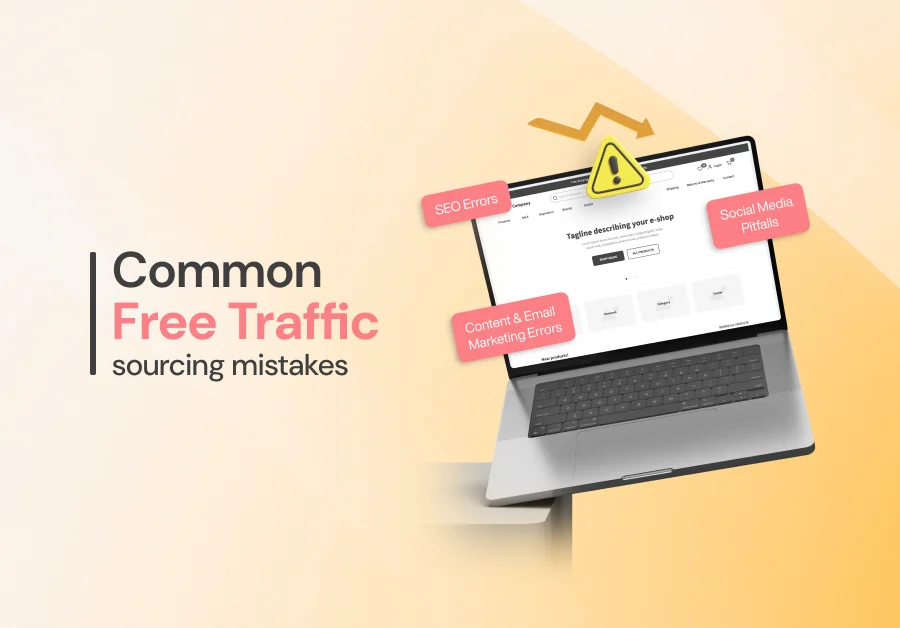
The common free traffic sourcing mistakes for a dropshipping store involve 3 major issues, including:
Search Engine Optimization (SEO) errors
Sometimes beginner dropshippers overlook SEO tactics and focus more on product sourcing. But without a strong SEO, you can’t get organic traffic to your website. Other SEO mistakes are:
- Using duplicate product descriptions directly from suppliers results in a search engine penalty and harms website ranking.
- Poor title, improper product descriptions, and empty meta tags mean your products won’t show up in relevant searches.
- Neglecting keyword research means your content won’t match your target audience’s search results.
- Engaging in “black hat” SEO practices leads to Google penalties or even the removal of your site from search results.
- Ignoring search intent & focusing only on high-volume keywords and transactional “buy now” pages is a big mistake.
- A bad site structure or a messy site is hard to navigate and confuses both users and search engine crawlers.
Social media marketing pitfalls
As we’ve mentioned earlier, social media is a powerful platform for driving free traffic to your dropshipping store. Ignoring the power of social share, you might lose potential traffic.
- Promoting your product/store to the general public instead of a specific target audience wastes your valuable time and effort.
- Using unsuitable channels where your target audience doesn’t spend time reduces potential reach and impact.
- Lack of consistent brand messaging across platforms can ruin brand credibility and engagement.
Content marketing & email errors
Generic or poor-quality content distracts organic traffic and positions your brand as an authority. Also, some are missing out on building an email list early. Other mistakes are:
- Lack of patience; expecting immediate results and giving up too quickly.
- Choosing an oversaturated dropshipping niche makes it difficult to stand out and target specific customer needs with free methods.
How to track free traffic success to your dropshipping store?
To track the success of free (organic) traffic to your dropshipping store, use analytics tools like Google Analytics (GA4) and Google Search Console to monitor KPIs, such as –
- Conversion rates
- Traffic sources, and
- User engagement metrics.
Below, we’ve discussed some helpful analytics tools that ease your success tracking:
Google Analytics (GA4)
This is the primary & helpful free tool to track website data. At first, sign up for your GA4 account and install the tracking code on your store. After that, you must enable “Enhanced E-commerce tracking” in your GA4 settings to get your organic traffic detailed data on:
- Product performance,
- Sales revenue, and
- Cart activity.
How to find organic data:
First, sign in to your GA4 account, then click on the “Reports” section. Under the “Life Cycle” section, click on the “Acquisition > traffic acquisition.” Here, you notice all your traffic sources, including “Organic Search.”
To see the specific search engine driving your organic traffic, scroll down to the “Traffic acquisition” report. Then add “Session source” as a secondary dimension.
Google Search Console (GSC)
It’s more directly tied to organic search than Google Analytics. From indexing status of your webpages to elaborating the performance of those pages in search, all the data you get using your GSC account. Some other key metrics are:
- Impressions
- Clicks
- Click-through rate, and
- Average position.
How to find organic traffic data:
Analyze which keywords are driving free or organic traffic to your store, see how your pages rank in search results, and identify technical issues that might impact your performance. First, go to your GSC account. Open the “Search results” report under “Performance.”
After that, you’ll notice the total number of organic clicks driving traffic to your store from Google’s search results. Then scroll down to see which queries, pages, and countries bring the most organic traffic.
Final verdict
So, there you have it! Seven proven ways to get free traffic to your dropshipping store.
You can use most tactics to attract organic traffic, but focus more on your niche to get the best results. Feel free to share your suggestions for the methods that are on this list, or if you have a tactic that’s not included but works well for you, let us know.
Good luck!
FAQ’s: Free Traffic on Dropshipping Store
How can I get free traffic for dropshipping?
You can get free traffic for your dropshipping by applying any of our 10 proven ways.
How can I increase Google traffic?
To increase Google traffic, focus on Search Engine Optimization (SEO) by creating high-quality content, optimizing your site for mobile & user experience, building backlinks, and others.
Which social media platform is the best free traffic source?
The best social media platform for a free traffic source depends on your specific goals and target audience. However, some effective social media platforms include Pinterest for visual content and long-term traffic, YouTube for video, and TikTok & Reddit for quick exposure and niche communities.
How do I get traffic to my store?
To get free traffic to your store, combine online and offline strategies like optimizing your website for search engines (SEO), using social media marketing, and engaging in paid advertising. Also, you can drive traffic, offering exclusive in-store promotions and loyalty programs.
How can I increase my online store traffic without SEO?
You can increase your online store traffic without SEO by using paid ads, building a strong social media presence, and creating valuable content through blogging, podcasts, or videos.
How to market your dropshipping store?
To market your dropshipping store, focus on both organic and paid strategies, build trust through reviews, excellent support, and personalized communication.
How to analyze the success of a free traffic source?
To analyze the success of a free traffic source, use analytics tools like Google Analytics and Google Search Console to track key metrics (i.e., conversion rate, bounce rate, and engagement time).